
Beyond the Money: Building Africa’s Investment Ecosystems
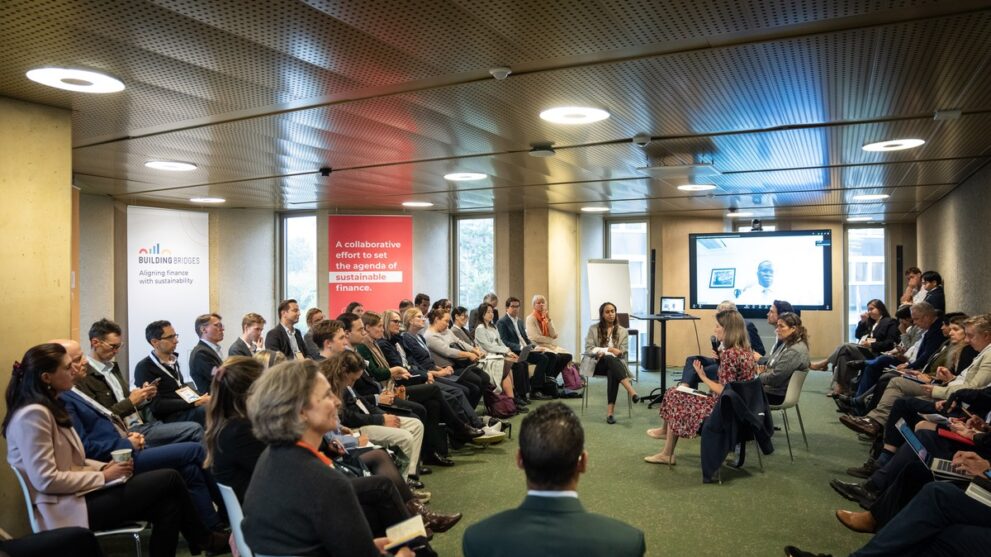
A “fishbowl” session is a conference with the walls taken down. A few speakers sit in the middle, and anyone in the audience can walk up, sit down, and join the conversation. On 8 October, in a packed room at the Geneva International Conference Centre, that format turned out to be the message itself: no one can build Africa’s investment future alone.
I came as a finance student from West Africa (Burkina Faso), with a few banking internships behind me and one ambition: to use fintech, digital training and the digitalization of financial systems to build financial independence, especially for women entrepreneurs, whose economic activities support their families and communities across Africa. Microfinance (small loans and savings for people that banks tend to overlook) stays an important starting point, but I now see digital tools as the way to reach further. This autumn I began the Master of Advanced Studies in Sustainable Finance, Impact Investing and Development at the Geneva Graduate Institute, and Building Bridges gave me a front-row seat on how the people who move this money think.
Risk that is seen, and risk that is real
Bumi Camara, Chief Fragility and Resilience Economist at the African Development Bank, joined remotely from the bank’s headquarters in Côte d’Ivoire. His warning was simple: investors often judge a whole country with a single label, so promising projects are screened out before anyone has studied them. Nigeria, he noted, is far too large and varied to carry one risk profile. Sandra Halilovic, who heads Acumen’s work in the world’s hardest-to-reach markets, made this tangible. In the Democratic Republic of Congo, funding for one company was put on hold because of conflict near a border, even though its operations were far away, in a country as large as Western Europe. In Somalia, half the population has no electricity and the rest pay about three times what an average American does, often for imported diesel, despite more than 300 days of sunshine a year. The risks are real, she said, from currency swings to affordability. So is the opportunity.
From emergency aid to lasting markets
Elizabeth Campbell, Founding Executive Director of CoAction Global, reminded us that many fragile places have been defined for decades by humanitarian aid: plastic sheeting and food parcels, but almost no investment. Because a parallel aid system paid the bills, governments had little reason to change the rules that stop refugees from working, moving freely or holding official documents. Her idea is to use development finance to reward governments that reform.
Patrick Elmer, CEO and Founder of iGravity, showed what this looks like in practice. His refugee investment facility chose countries where refugees can travel, take jobs and open bank accounts: Uganda, Jordan, Kenya, and Colombia. Its loans are “impact-linked”: the more a business achieves for vulnerable communities, the cheaper its borrowing becomes. Finding the first businesses ready for investment took about two years, and one potential investor at once asked how the facility would ever reach 100 million dollars. An honest question, and a useful one.
The missing ingredients: people and patience
Patrick Egli, from the Swiss Agency for Development and Cooperation, described “patient capital”: money willing to take the first risk so that others dare to follow, and ready to step aside once local finance takes over. He also challenged the room: why were we, mostly from the global North, discussing Africa in a bubble? Real inclusion, he argued, means African voices and African-led funds at the table.
Bumi Camara summed up the lesson in one sentence: capital alone does not create investability. Money becomes investable when it meets market knowledge, a pipeline of ready businesses, shared risk, and coordination between everyone involved. That is the logic of the Humanitarian and Resilience Investing Roadmap for Africa, led by the World Economic Forum and the African Development Bank, which aims to mobilise 10 billion dollars, support 1,000 businesses and launch ten country alliances by 2030. Elizabeth Campbell added the unglamorous truth: human capacity costs far less than people assume, and it must be funded alongside the capital.
A seat for everyone
The audience made the ideas concrete. An entrepreneur who farms fish in Zimbabwe, Zambia and Mozambique asked whether the roadmap could help him grow from 1,000 to 5,000 tonnes a year. The answer was yes: Mozambique is one of its starting countries, and his business could join the pipeline. A bridge, I realised, begins the moment someone asks, “is this for me?” and hears a yes.
How this changes my thinking
I used to ask how much money was available. I now ask who prepares the businesses, who changes the rules, and who pays for the people doing the patient work. For my own ambition in West Africa, that means microfinance will not scale on funding alone: it needs trusted rules, local ownership and teams close to the ground. The session did not make me naive about risk. It made me more precise about it, separating the risk that is perceived from the risk that is real, and building around the second. Take the empty chair If you work in finance, policy or humanitarian response, choose one bridge to build this year: share a structure that worked, fund the human side of a project, or open your pipeline to a new partner. And if you are a student like me, do what the fishbowl invites: take the empty chair. The conversation is better when more of us are in it. Join the Building Bridges community and bring one question with you.
Author: Léïla Fabiola Bienvenue D. SIGUÉ, Master of Advanced Studies in Sustainable Finance, Impact Investing and Development.
Guest Contribution: This article is brought to you in collaboration with the Geneva Graduate Institute, an Ecosystem Partner of Building Bridges 2026.
Photo Credit: Laurent Cipriani.
Note: The views, information, data and figures presented in Guest Contributions are those of the respective authors and do not necessarily represent views or position of Building Bridges. Information, data and figures provided by guest contributors have not been independently verified by Building Bridges.