
Smart Structures, Bold Conviction: Investing in Africa’s Frontiers
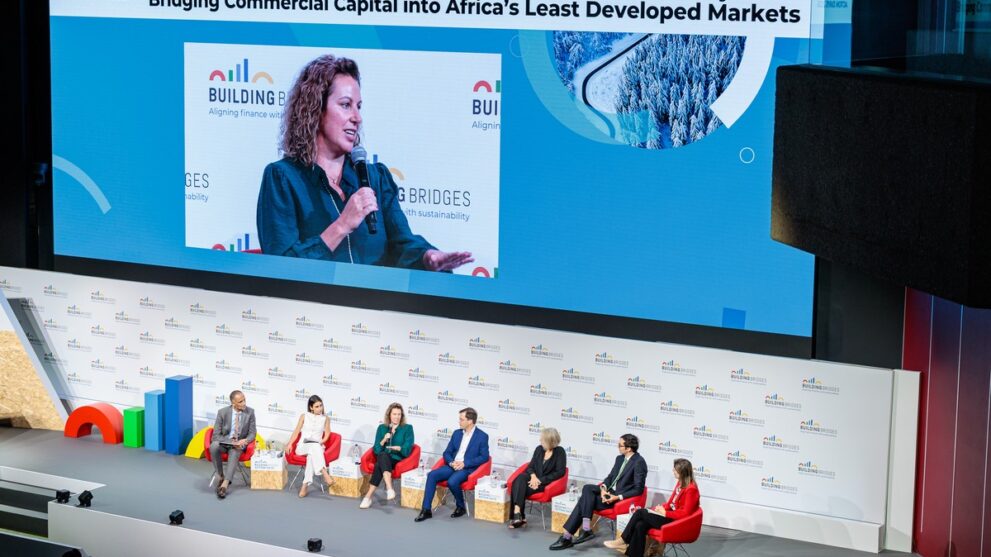
Of the world’s 44 least developed countries, 32 are in Africa. Since 1971, only three African nations have left that list, while the United Nations hopes for fifteen graduations by 2031. On 7 October, a panel on bridging commercial capital into Africa’s least developed markets tackled the obvious question: where will the money come from? The answer I took away was surprising. It is less about finding more money than about designing better bridges for it to cross. As a West African finance student who wants to work in microfinance and digital financial services, I sat down in Room A with one question: how do you convince a cautious investor to back a small business in a fragile market? The panel, led by the Swiss Agency for Development and Cooperation and TLG Capital, offered real answers, and a few honest admissions.
The squeeze on grants
Christian Frutiger, Vice-Director General of the Swiss Agency for Development and Cooperation, opened with a stark figure: reaching the Sustainable Development Goals needs an extra four to six trillion dollars every year, while development aid is shrinking. Agencies, he said, must move from grants towards investments that attract other capital. Corina Gardner, CEO of the IDP Foundation, agreed: scarce grant money should go only where no other capital can do the job. Building schools, for instance, suits borrowing, because the schools her foundation backs repay their loans at around 97 percent.
Why copy-and-paste finance fails
Isaac Marshall, Senior Investment Professional at TLG Capital, challenged a common habit: applying rich-world playbooks to African markets. Taking a claim on land or buildings as security sounds safe, until courts cannot enforce it and nobody can sell the asset. TLG works differently. Local banks open their loan books, point to borrowers they trust but cannot fully fund, and back TLG’s loans with guarantees. A guarantee is simply a promise to cover the loss if a borrower cannot pay. His boldest claim: in his view, the biggest risk is often crowded competition, not the frontier itself.
Three partners, one clever guarantee
Corina Gardner told the story that stayed with me most. Her foundation wanted to unlock lending to an education company in Kenya without moving money out of its endowment, the long-term fund that sustains its work. Instead of handing over cash, it pledged a guarantee backed by a standing line of credit, so the endowment keeps growing. TLG then converted the guarantee into a loan in local currency, at about 14 percent interest, and agreed to absorb the first losses if the currency fell. The result: a private dollar now flows towards schools in low-income communities. Trish Thomas, CEO of Cascador, a Nigerian entrepreneurship platform, starts with people. She looks for “learning multipliers,” founders who quickly turn knowledge into results, supports them, then lends in forms their business can truly repay. Sandra Halilovic of Acumen explained how 23 funders with different expectations allowed her team to tailor each loan, even lowering interest when social targets are met.
When Africa is missing from the map
Maya Burney, Senior Investment Officer at Calvert Impact, described a three-decade record of repaying the investors behind her organisation, and a motto: “no margin, no mission.” Recent African deals, she explained, were approved not because risk disappeared but because protections were built in guarantees, shared first losses and blended funding, which mixes public or philanthropic money with commercial capital.
Then came the most candid moment. Nicolas Salomon, Investment Coordinator at the CERN Pension Fund, speaking in a personal capacity, explained why Africa receives so little: large investors follow benchmarks, the standard market indexes that guide where money goes, and Africa barely appears in them. Stepping outside the benchmark means convincing many committees and risking one’s career. Isaac Marshall replied that benchmarks change when success stories pile up: after three years of regulatory work, a Nigerian fund backed by local bank guarantees raised its money from pension funds in four months, and two more funds have followed.
Belief, borrowed strength and a long view
Questions from the room pushed further. How do you reach countries with shallow financial systems? Isaac’s answer: borrow strength from neighbours, using guarantees from stronger banks, for example in Tanzania, to lend into Burundi or the Democratic Republic of Congo. Corina urged us to look at micro-markets inside countries, where incomes and risks differ widely. And one panellist argued that change is rarely linear: it builds quietly through countless small signals, then arrives suddenly. Our job is to build enough proof that capital is ready when it does.
What I take with me
Three lessons will shape my path. First, structure capital around what a business can repay, with attention to currency and collateral, instead of copying models from elsewhere. Second, trust local institutions: banks, pension funds and partners across borders already understand the ground. Third, conviction matters: capital follows belief, and every successful deal makes the next one easier. For my goal of strengthening microfinance in West Africa, this is both a toolkit and a reminder that small, carefully designed deals can move big systems. Cross the bridge Around four in ten people alive at the end of this century are projected to be African. Investors, banks, foundations, and policymakers: the next move is yours. Share what you have learned, publish your structures so others can copy them, and fund the people behind the numbers. And to fellow students: keep asking the uncomfortable questions. Bridges only get built when someone steps forward to lay the first plank.
Author: Léïla Fabiola Bienvenue D. SIGUÉ, Master of Advanced Studies in Sustainable Finance, Impact Investing and Development.
Guest Contribution: This article is brought to you in collaboration with the Geneva Graduate Institute, an Ecosystem Partner of Building Bridges 2026.
Photo Credit: Antoine Tardy.
Note: The views, information, data and figures presented in Guest Contributions are those of the respective authors and do not necessarily represent views or position of Building Bridges. Information, data and figures provided by guest contributors have not been independently verified by Building Bridges.