Bridging Capital and the Real Economy with Holcim
Following the Post-Building Bridges Executive Lunch in Geneva, we sat down with Antonio Carrillo, Vice-President of Sustainability at Holcim, to hear his thoughts about the role of corporates in the transition towards sustainable finance.
—
Holcim has been a visible real economy voice at recent editions of Building Bridges. What have you found most valuable or unique about the continued engagement?
What struck me from the beginning was the range of topics we were able to engage with. At Building Bridges, from climate action, to nature, all the way across sustainable finance all in the same space. That variety is a unique feature of this forum and its holistic approach is essential. Building Bridges helps us make a crucial connection, which is the link with the financial community. In many global forums, financial actors can feel very far away from the technical discussions. Building Bridges manages to bridge that gap. It brings together capital markets and the real economy in a very practical way.
Is there a conversation or insight from your participation with Building Bridges that has stayed with you or shaped your thinking?
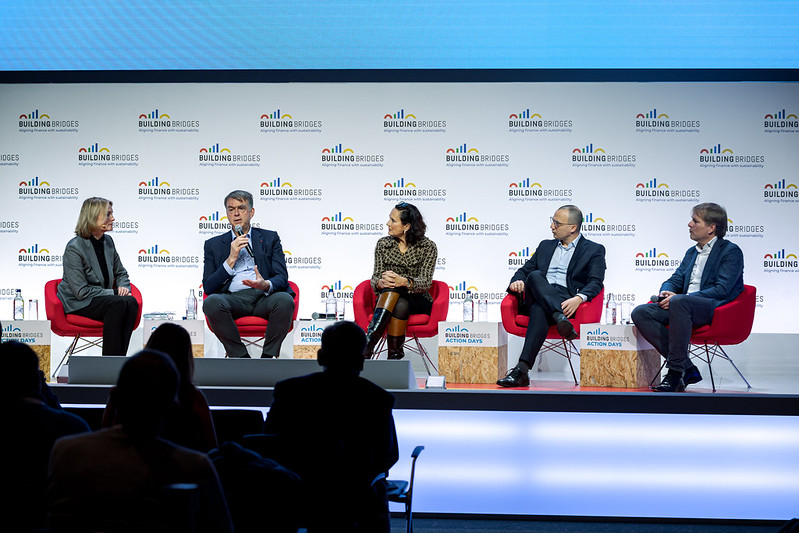
On a personal level, I was genuinely impressed by my interaction with André Hoffmann during my contribution in 2024. I unexpectedly found myself on the main stage (view the session here) due to a series of last minute changes. It was amazing. Holcim had contributed to André’s book on circularity, and so engaging with him in that setting felt like a natural continuation of earlier collaborations. It made me reflect on the role of leadership and vision in the ESG space and on how Building Bridges creates the conditions for constructive, informed dialogue across sectors. Leadership in this space is fundamental. Holcim’s CEO Miljan Gutovic is deeply involved in our strategy, ensuring sustainability is not only the right thing to do, but a driver of profitable growth. Leadership in this transition is paramount, and I am proud that Holcim has consistently been at the forefront of sustainability, climate action and nature action. It is part of our DNA and one of the many reasons people choose to work at Holcim.
The transition ultimately relies on both capital and implementation. Where do you see the strongest opportunities for collaboration between industry leaders like Holcim and the financial sector?
The strongest opportunities lie in aligning credible transition pathways with financial support. It is important that the financial community is equipped to identify what a credible transition plan looks like and is ready to back it. We do not need more controls. We need readiness and confidence to support what works. Markets also need to be brave enough to fund large scale decarbonisation projects because these are essential. Investors can reinforce progress by supporting companies that set robust targets, define clear plans and then execute them. There is more to explore in transition finance, including dedicated transition funds and I hope to see more of these in the near future.
What developments, technological or operational, do you see creating the greatest momentum for decarbonisation across your sector?
Our efforts are focused on three main levers: developing innovative low-carbon formulations, optimizing our energy mix and deploying advanced technologies such as carbon capture utilization and storage (CCUS). In the area of formulation, we’re making solid progress on the use of alternative raw materials and mineral components. One of our main focus areas is scaling the use of a calcined clay, which can be used as a replacement for clinker in the final product mix. With regards to energy, we continue to increase the use of alternative fuels from the recovery of non-recyclable materials. In Europe today, more than a dozen of our cement plants already use alternative fuels to cover more than 80% of their energy needs. And lastly, advanced technologies, where Holcim has secured EU Innovation Fund grants for eight of their projects. CCUS is already proven in other industries. The focus now is on deploying it in cement and construction materials at scale and doing so cost effectively. This is what will deliver deep decarbonisation in the next decade. We need continued work on the business cases including the entire value chain from capture to transport to storage – both onshore and offshore – as well as utilisation. Every step of the process requires alignment, ownership and an ecosystem approach supported by public funds and private investment.
You travelled from Zurich to Geneva today. How do you see the two cities working together as complementary financial centres with strong industrial leadership to position Switzerland for the transition?
Zurich and Geneva offer mutually reinforcing strengths, putting Switzerland at the forefront of the global transition. Zurich brings its corporate and financial depth while Geneva offers its international reach and industry networks. Together they bring investors and real economy-actors to the same table. As a founding member of WBCSD, Holcim has long been part of Geneva’s sustainability landscape, and since the beginning of my sustainability career, engaging here with non-financial institutions and associations has felt both natural and essential. Our engagement extends beyond Geneva to Vevey and longstanding partnerships with organisations like IUCN. The train journey offers time to reflect, get some work done and it’s great to have the convenience of a same-day return and be back home in the evening.
We Build Bridges Storytelling Series
Building Bridges is more than just an event, it’s a space for meaningful collaboration, fresh perspectives, and lasting connections. Through our storytelling series, we highlight the personal experiences that shape each edition. If you have a story to share about your engagement with Building Bridges, whether it’s a key insight, a memorable moment, or the impact of the bridges built, we’d love to hear from you at community@buildingbridges.org.