Swiss Carbon Markets: From Building Integrity to Financing Scale
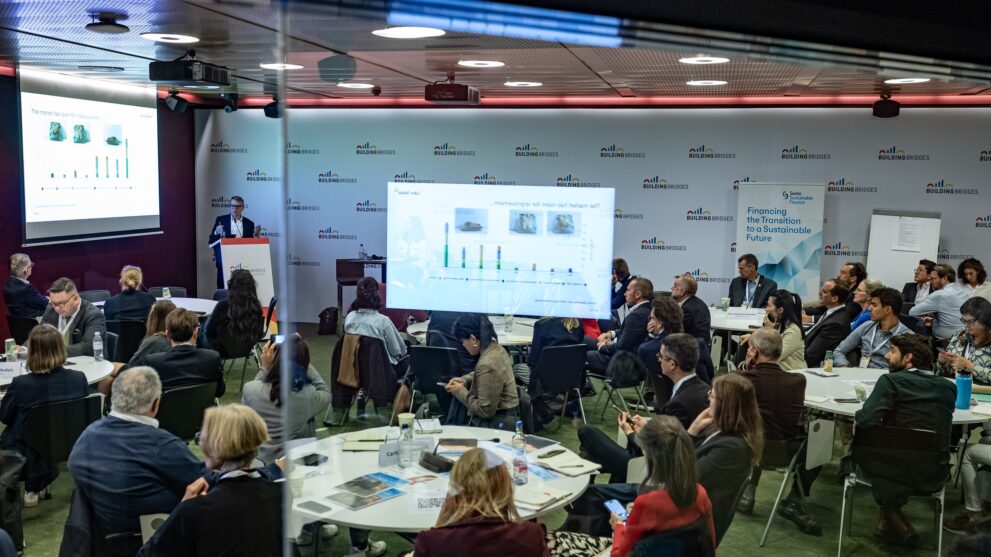
Following Building Bridges 2025, we sat down with Anik Kohli, Partner at INFRAS and Board Member of the Zurich Carbon Market Association and Romain Leroy-Castillo, Director AI and Education at Swiss Sustainable Finance, to hear their thoughts about the momentum in Swiss carbon markets. This follows a number of major events on the topic this year including the Action Event at Building Bridges they co-organised, titled Investment Opportunities in Carbon Markets.
You’ve both been closely involved in Switzerland’s carbon market journey. What moments or insights from this year — from the August event with SSF, SIX and McKinsey to your session at Building Bridges — best capture how far the discussion has come?
Anik: It was really encouraging to see the emphasis on high-integrity carbon markets throughout all these events and discussions. That focus is crucial to avoid the reputational risks that have hurt carbon markets in the past. Financial institutions need trust and reliability, and without that, capital will not flow. We all remember the scandals of 2022. The market is at a crossroads now, and this is the moment to reorient around the Paris Agreement. First, the Swiss bilateral agreements under Art. 6.2 represent an improvement in integrity over the rather weak standards of the voluntary carbon market (VCM). Second, the new Art. 6.4 top-down UN rules are agreed, and they bring long missing credibility to the public that carbon markets with strong rules are possible. All international carbon markets need to move towards integrity if we want to unlock their full potential. Build integrity and scale will follow – as the Integrity Council for the VCM puts it.
What really stood out this year was how consistently that message came through. Every event, not just ours, placed integrity at the core of the discussion. Building Bridges made that possible by connecting innovators from the real economy with financiers and policymakers, creating a shared space where standards and market perspectives could meet. That interaction is what drives collective learning forward.
Romain: I completely agree. The scandals in 2022 did cost the voluntary carbon markets a couple of years : the discussion stalled and trust took a hit. But this year you can feel the dynamic returning. Two things really stood out to me. First, time is getting short to meet the first emission reduction targets by 2030. That urgency is sharpening attention and driving interest. The industry is showing up again, and all events we organised this year were full. Second, the scale of new technical solutions is impressive. Direct air capture and storage, for example, has seen an incredible wave of innovative solutions brought forward by companies of diverse sizes. At our events we showcased a few, and I would love to see an even broader representation of such technical solutions at events like Building Bridges going forward.
However, there is still insufficient link between the real economy and finance. There is not yet enough understanding in financial institutions about what is actually happening on the ground. More translation between engineers, project developers and investors would benefit the whole ecosystem. Integrity is at the heart of credible carbon markets.
Can you share examples of how Swiss actors are working together to build that trust, whether through new standards, data systems or partnerships?
Anik: It is not just one initiative, it is really an ecosystem effort. Within the Zurich Carbon Market Association (ZCMA) board, we have several actors deeply engaged in integrity work. At INFRAS, for example, we are involved in the Integrity Council for the Voluntary Carbon Market. Others in the network are supporting the methodological work of the Paris Agreement Carbon Market (PACM) and host-country capacity building. We also have the Swiss Federal Office for the Environment (BAFU) and State Secretariat for Economic Affairs (SECO) in the ZCMA board. It allows practitioners and policymakers to exchange directly and learn from one another. That is one of the main reasons ZCMA was founded, to keep those dialogues active and connected.
Romain: Trust, integrity and credibility are still top of mind for everyone. Governance has improved a lot, for example with the development of the Core Carbon Principles, but memories of past failures remain in the back of most people’s minds. Because trust is built progressively and earned over time. That is why a whole value-chain approach is so important. You cannot rely on one certification or one data feed alone. Trust comes from a robust chain with many actors contributing to transparency and integrity. In Switzerland we are lucky to have a full ecosystem of market participants, from project developers to standard agencies, monitoring and reporting solutions, exchanges, and intermediaries.
At our event and others we saw that alignment. It is encouraging to hear consistent messages, whether from industry, financial services or international organisations. It shows that Switzerland’s ecosystem is already quite advanced in terms of collaboration and shared learning.
How does what is happening in Switzerland connect to the wider global conversation, especially around COP30 and the implementation of Article 6?
Anik: The Swiss government plays an active role internationally. It is negotiating bilateral agreements under Article 6.2 with countries such as Thailand and Peru and also contributes to the development of Article 6.4 rules. That means experts who are active in these global processes also participate in national discussions, like those at Building Bridges and ZCMA events. It is a direct link between international rule-making and local practice. At COP30, Switzerland can play a constructive role in ensuring integrity and credibility as forestry methodologies and other standards evolve.
Romain: Yes, Switzerland may be small but the ecosystem is remarkably complete, as we said earlier. You find technology-based and nature-based project developers, certification expertise, monitoring providers and intermediaries such as South Pole, all operating globally. There are also public instruments like the KliK Foundation, which finances climate mitigation projects abroad and brings those results back through the bilateral agreements already mentioned. So Switzerland actively contributes to shaping how high-integrity implementation happens.
When we meet again next year, what progress or breakthroughs would you hope to highlight, in Switzerland and beyond?
Anik: I would love to see continued collaboration across platforms, ZCMA, SSF, Building Bridges and others. Over the past two years we have built real momentum. The next step is positioning Switzerland as a hub for high-integrity carbon markets and related financial products that channel capital towards credible outcomes.
Romain: I hope that by next year we start seeing a rise in demand again in the voluntary market, aligned with 2030 targets. And I wish we will speak further about solutions, risk management and business opportunities. People want to hear about investability. We need to deepen these conversations around pricing, reputational and financial risk, investability criteria, real-time monitoring. And last but not least, insurability. Because nothing scales without insurance, and the more we help insurers develop models for this space, the faster the market will mature.
About ZCMA
Zurich CMA is a non-political membership organisation interested in the evolution of sustainability focused and high-quality carbon markets. Their upcoming event “Digesting the 30th Climate COP in Belém” takes placed on 11 December, 2025 (online or in person at INFRAS Zurich office). Register now to learn first-hand impressions and analysis on progress made from negotiators and observers.
About Swiss Sustainable Finance
Swiss Sustainable Finance (SSF) is the leading Swiss association in the field of sustainable finance. The mission of SSF is to strengthen Switzerland’s position as a leading voice and actor in sustainable finance, thereby contributing to a sustainable and prosperous economy. Sign up to their newsletter here.
—
We Build Bridges Storytelling Series
Building Bridges is more than just an event, it’s a space for meaningful collaboration, fresh perspectives, and lasting connections. Through our storytelling series, we highlight the personal experiences that shape each edition. If you have a story to share about your engagement with Building Bridges, whether it’s a key insight, a memorable moment, or the impact of the bridges built, we’d love to hear from you at community@buildingbridges.org.
Photo credit: Antoine Tardy