Beyond Fossil Fuels: Johan Rockström on Science and the Economic Transition
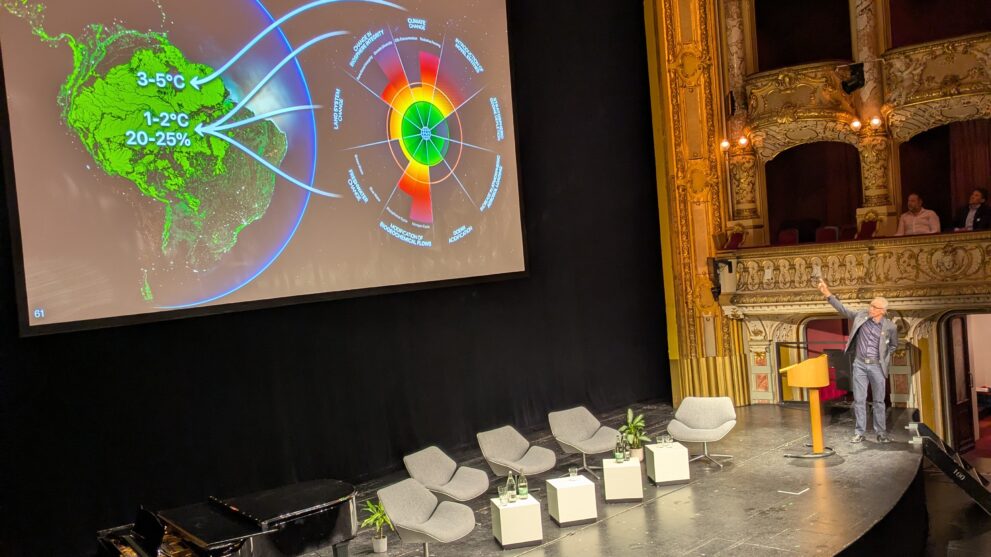
During Climate Week Zurich 2026, Building Bridges had the opportunity to sit down with Johan Rockström, Director of the Potsdam Institute for Climate Impact Research and one of the most influential planetary scientists of our time. His message to the Building Bridges community focused on the economic case for moving beyond fossil fuels — and why aligning markets, capital and policy with planetary boundaries is not only necessary, but economically compelling.
—
Johan, thank you for speaking with us at Building Bridges. The last time you addressed our community was in 2024, when you joined our Summit in conversation with Nik Gowing. At the time, you presented the new planetary boundaries framework and warned that we were approaching critical tipping points. This morning, you said we have now breached seven planetary boundaries, painting a very urgent and alarming picture of the road ahead.
From your perspective, where do you see the biggest underestimations today between what the science tells us and how economic and political actors are responding?
Thank you, and thank you for the opportunity to continue this discussion. If we look at this by stakeholder groups, one stakeholder group that continues to underestimate the situation is industrial actors still deeply locked into fossil fuels, particularly parts of the oil and gas industry, but also countries that are highly dependent on oil, gas and, to some extent, coal. That remains a major challenge. Also, what is striking today, in 2026, is that despite everything we know, we are seeing a revival of climate denialism. Climate denialism has changed character: it has moved from ridiculing science to accepting the science, but then offering countless arguments about why action is too expensive, socially unjust, or incompatible with development in emerging economies.
Another very important group is what I would call the vast middle ground: political leaders and private sector leaders who are not questioning the science and are not deeply invested in fossil fuels, but who are uncomfortable with the scale of transformation required. We have 200 years of operating within a fossil fuel-driven economic logic, and now we are talking about replacing internal combustion engines, phasing out plastics, and fundamentally redesigning infrastructure. Many actors simply remain passive because there is a strong human preference for incremental change.
We see this even in climate negotiations. At COP30-related discussions, around 80 countries opposed adopting a roadmap to accelerate the phase-out of fossil fuels, while 80 supported it. In my assessment, the majority of those opposing are not truly against the transition. They are sitting on the fence. Many are importers of oil and gas, locked into fossil-based infrastructure through state-owned utilities and long-lived assets. They face real transition challenges, but they are also the greatest opportunity, because they are not rejecting the science.
The transition is perceived—often quite rightly—as bumpy at the beginning. What we sometimes underestimate, including in the scientific community, is just how difficult those early stages can be. And yet, we also know that once we reach a fossil free, electrified economy, the benefits are overwhelming: better health, greater security, more equity and stronger competitiveness. The real challenge is getting through that initial gauntlet.
Finally, there is still a remarkably high level of public misunderstanding about risk. Scientifically, we have not communicated clearly enough what 1.5°C actually means. Many people think of it as a target or a goal. It is not. It is a limit, a threshold beyond which we enter danger. It represents the warmest temperature on Earth since we left the last Ice Age. If people truly understood that 1.5°C is a very large number in Earth system terms, political and business action would be much stronger.
Is there a human dimension that explains the difficulty in grasping risks that feel distant, complex or overwhelming? How can we communicate the reality of 1.5 degrees and tipping points more effectively?
Yes and no. I remain somewhat stubborn on this. I am convinced that communicating risk is not only necessary but positive. People deserve an honest assessment of risk. For many years, scientists have been discouraged from communicating risk strongly, based on the idea that it leads directly from denial to despair. I question that assumption. There is strong evidence that adrenaline – responding to real threat – is a powerful motivator.
The Fridays for Future movement was born out of fear and urgency, not out of a vision of a green utopia. That said, I fully agree that risk communication cannot stand alone. If a doctor tells you that you have a serious illness, you also need to hear about treatment options. We must always pair diagnosis with agency. But sustainability has too often been framed as a feel-good agenda, and that has not helped us.
When I speak with business leaders, I often hear impressive ESG stories: electric vehicles competing with combustion engines, green textiles gaining market share, sustainable food performing well. What I point out is that they are succeeding despite massive distortions in the market. Fossil based products are effectively subsidised in multiple ways: through public policy and direct subsidies, and because their environmental and human health costs are not priced into the market. Competing on a level playing field would dramatically accelerate the transition.
Solar and wind are winning despite trillions of dollars in fossil fuel subsidies. That is not a dark story, it is a deeply positive one. Importantly, we now see risk science translating into law, finance and insurance. Reinsurers, actuaries and even institutions like the International Court of Justice are integrating climate risk into decision-making. That is a powerful and operational use of science.
You have helped create frameworks and tools that make planetary boundaries more accessible. How are you seeing these used in decision-making?
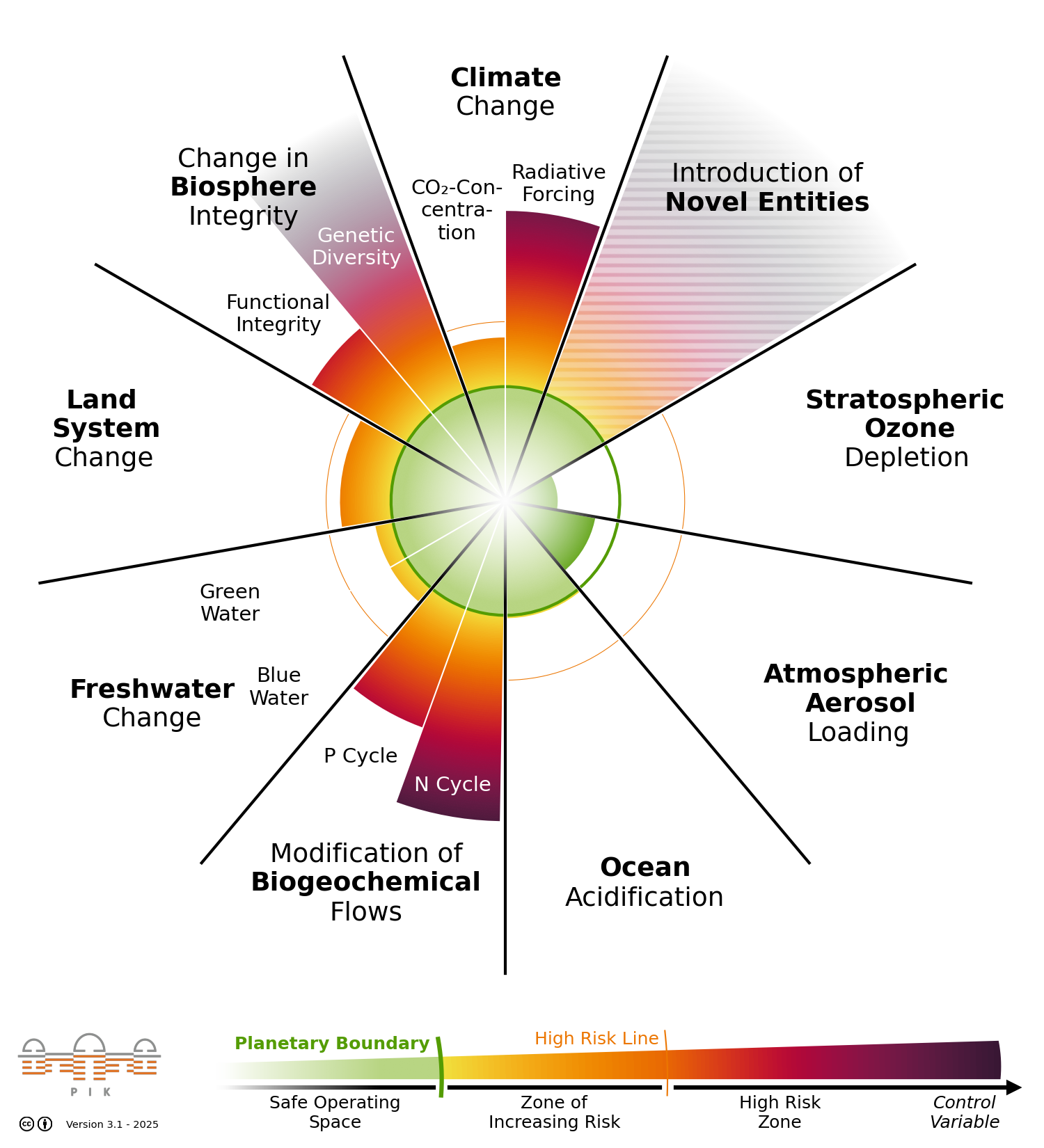 Two years ago, we launched the Planetary Boundary Initiative, structured around three clusters.
The first focuses on diagnostics: the science of planetary boundaries, tipping points and Earth system risk assessment. This work establishes where we are exceeding safe limits, where risks are accelerating, and what that means in terms of systemic threats to economies and societies.
The second focuses on solutions, we are working in partnership with the London School of Economics to map how companies, cities and countries are operationalising planetary boundary science in practice. There are already examples. Companies like Oréal and Houdini are explicitly using planetary boundaries as guiding frameworks, and over time firms such as Unilever and Walmart have engaged with this science in shaping their sustainability strategies.
The third focuses on decision making and policy, where applications are already visible in cities like Amsterdam and Copenhagen, and in countries such as New Zealand under Jacinda Ardern. This will also be incorporated in the solution mapping.
Used in this way, the planetary boundaries framework can function as a dashboard for future development, helping decision makers quantify risks and avoid unintended trade offs. Take electrification as an example: it can have impacts on land use, water and biodiversity. Starting with a full systems accounting from the outset allows those trade offs to be identified early and managed more effectively.
At the 2024 Summit, you argued that countries in the Global South need leadership from Europe and the US. But today, you describe meaningful momentum elsewhere, such as the Santa Marta process launched in Colombia. What is this and what does this signal?
The Santa Marta process is one of the most promising developments we have today. Fifty-seven countries have committed not only to expanding renewables, but to phasing out fossil fuels in absolute terms, guided by science. A science panel has been established to support this transition by downscaling mitigation pathways to country level and mapping policies, technologies and financial mechanisms. This could become a powerful learning engine for global climate negotiations.
Many countries currently sitting on the fence – the middle ground I mentioned earlier – may shift once they see tangible benefits: energy independence, health improvements, security and competitiveness. There are already strong examples in Africa: Ethiopia is strongly pursuing electrification through regulation, supported by new hydropower capacity and Kenya is advancing rapidly, as are South Africa and Nigeria. Africa has enormous solar potential so the role of science now is to document these experiences and feed them into global decision-making.
Earlier today, we heard the argument that fossil fuel demand is still likely to increase. How do you respond to that?
I think we are at a balance point. It could go either way, but I believe that argument is wrong. So far, renewables have largely met rising energy demand without bending the fossil fuel curve. That is true. But I believe we are about to see an absolute decline in fossil fuel use. Once that decline begins, the transition will accelerate, because the advantages are already evident, even in an unfairly subsidised market.
China is a key signal. It is likely to peak emissions earlier than officially stated, perhaps around 2027–2028. Electrification of two-wheel mobility in China is already transformative. India is also moving, driven by air quality, energy security and economics.
This does not mean fossil fuels disappear overnight. There will still be hard-to-abate sectors: chemicals, plastics, aviation, heavy industry. Net zero is not absolute zero. But the direction of travel is clear.
There is increasing discussion about the balance between mitigation and adaptation. How do you see that balance?
Adaptation is absolutely necessary, there is no doubt about that, but it must go hand in hand with mitigation. With a 1.5°C world ahead of us, we must act now both to prevent the further breaching of planetary boundaries, where planetary resilience is weakened, and to adapt to a rapidly transforming world. Regulators, policymakers and networks have a responsibility to protect the space for mitigation, whilst investing in adaptation.
One of the pitfalls of adaptation is that it can mask the true scale of the catastrophe we are facing. Take snow as an example: be it on Swiss ski slopes or for the Swedish Vasaloppet, the historic Nordic ski race named after King Gustav Vasa, through artificial snowmaking, people do not feel, in a very tangible way, that winters are changing. Adaptation can therefore reduce the social and political signals that something is deeply wrong. It smooths over disruption, which can weaken the sense of urgency needed for mitigation. The real challenge is to do both at once: to adapt intelligently and fairly to the changes that are already locked in, while at the same time accelerating mitigation at a pace that actually reduces future harm.
Looking ahead to Building Bridges in October, our seventh edition, what concrete progress would you hope to see, particularly from the finance community?
Finance has a central role. I would like to see far more financial actors adopt scientifically grounded criteria across climate, biodiversity, freshwater and other planetary boundaries. Sustainability should no longer sit in a side pocket. It should define the mainstream portfolio. May to October is a short window, but I would like to ultimately see that we abandon the label “sustainable finance” altogether. Planet-aligned finance should simply be finance. Everything else should be considered misaligned.
In practical terms, the message is clear: stop investing in coal, and stop investing in new oil and gas. These are assets at the beginning of their end. Capital should flow towards systems that build resilience and long-term value.
—
Watch Johan Rockström and Nik Gowing at the Building Bridges 2024 Summit
—
We Build Bridges Storytelling Series
Building Bridges is more than just an event, it’s a space for meaningful collaboration, fresh perspectives, and lasting connections. Through our storytelling series, we highlight the personal experiences that shape each edition. If you have a story to share about your engagement with Building Bridges, whether it’s a key insight, a memorable moment, or the impact of the bridges built, we’d love to hear from you at community@buildingbridges.org.