Towards a Regenerative Economy – A conversation with John Fullerton
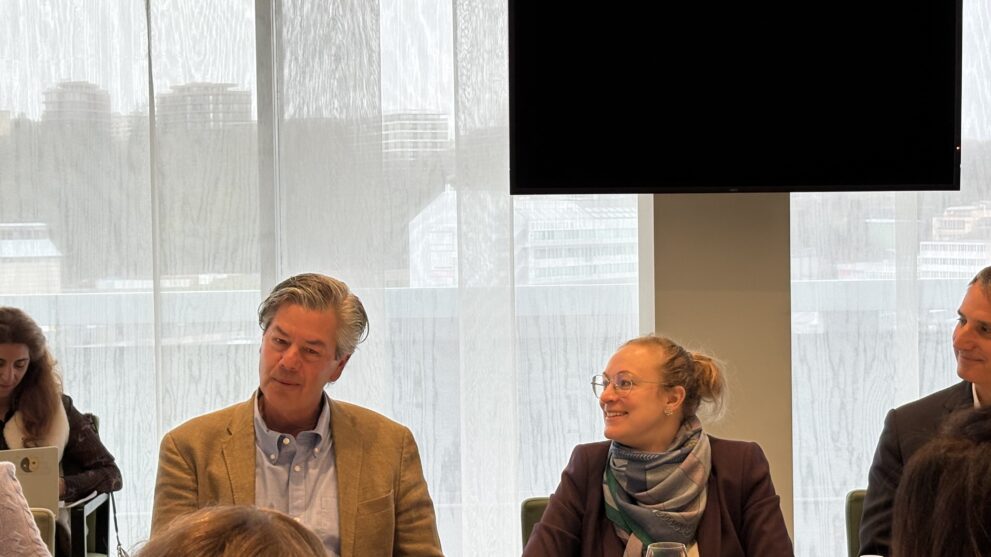
Following an executive breakfast on 26 March with special guest John Fullerton, former JP Morgan executive, founder of the Capital Institute and author, Building Bridges spoke with him during his European book tour. The conversation explored the current financial system, the future of a regenerative financial system, and how finance can move from fragmentation to integration.
You’ve had such a broad career, starting at JP Morgan— the old JP as you mentioned—before moving away from capital markets into private equity, impact investing, and now also as an author and educator. Given your experience across these different perspectives, what has been one of the most positive movements or areas of progress in sustainable finance that you’ve witnessed?
Well, you know, I was an early participant, as you mentioned, in what we call now impact investing. And I think there’s of course, plenty of criticism and disappointment in the scope and scale of impact investing, but I think it’s by far the most promising and profound expression of trying to rethink the purpose of capital in commercial enterprise and in our broader society. It’s easy to be critical, but the fact that impact investing is now a movement and has energy on its own is, what I would call the green shoot of reimagining what’s the purpose of capital.
In your view, what are the main limitations of today’s financial system when it comes to addressing interconnected crises such as climate change, inequality, and ecosystem degradation?
We in finance have mastered the project of fragmentation, we fragment risk into buckets, assets into asset classes, businesses into discrete sectors, and portfolios into sectors. And so, everything we do breaks wholes into parts and manages parts. By doing that, we create concentrations and efficiencies, but we lose sight of the interconnections, almost by design.
We have operationalised this fragmentation of our understanding of how the whole works. And it’s no different than what we’ve done in medicine, fragmented into specialists for every part of the body. So, fragmentation is the dominant theme of modern society, and finance is at the heart of it.
What’s missing is the integration layer, we’ve lost sight of how everything connects, even though that is ultimately what reality is. And this fragmentation can lead to chaos, to what we call a polycrisis. So, while finance has driven this fragmentation, it should also lead the reintegration of our understanding of the whole.
You have been a leading voice in advancing regenerative economics through your work at the Capital Institute. Can you define regenerative finance?
Sure, regenerative finance is easy. Regenerative finance is a finance practice in service to a regenerative economy. Finance is a subsystem of the economy, and we behave and treat it as if it’s the organizing power of the economy, so there’s an inversion required.
Defining a regenerative economy is a little more complicated, and I have kind of an official one in the book, but in essence, a regenerative economy is an economy that operates in accordance with the patterns and principles that describe how all life works, which is different than an economy that just doesn’t break nature or an economy that’s inclusive. It’s a participation in the process of life. It requires us to understand that we’re a part of nature, not apart from nature trying to protect nature.
In indigenous languages, there isn’t a word for nature. There’s a way to say ‘my relationship with the tree’ or ‘my relationship with the river,’ but there’s no human versus nature. We don’t other nature, and that othering is in conflict with the interconnection of whole life, which is not just a kumbaya thing, it’s actually Nobel Prize winning physics.
It’s called entanglement. So, we’re running the economy and finance in conflict with the law of entropy and now the understanding of entanglement, which are two of the most profound revelations of physics. And we’re running the economy in conflict with them, and often naive to the fact that they even exist. And what most economists, most investors, most bankers, would not be able to tell you is why the second law of thermodynamics is relevant to economics and finance.
Looking ahead, what would a successful transition to a regenerative financial system look like in practice, and what are the key barriers to getting there?
Well, I absolutely think it’s possible, in fact, I believe it’s inevitable, because it’s reality. It’s a self-evident truth that the human economy is a living organism. What I don’t know is the degree to which the organism will collapse in order to reorganise. But it’s inevitable that it will either collapse and reorganise, or it will transform with mitigated collapse. But collapses are happening today, so we can’t say it won’t collapse.
And so, the first and most important thing is this re-education piece, because without this holistic understanding, we will continue to whack-a-mole, trying to solve problems, at best having some short-term victories but no long-term win, and at worst creating bigger problems. For example, the Green Revolution was problem-solving, we were going to solve poverty and now we’ve destroyed soil, which is a way bigger problem than intermittent poverty.
And this is the reason I’ve chosen to focus my work on education. I would describe it as education, illumination, and initiation, it’s initiation into seeing the world through a new lens. And once you do that, you can’t unsee it. That, to me, is the most powerful force—imagine millions of people who can’t unsee this and who dedicate the rest of their working lives to whatever aspect of this is right for them.
I see this happening, people quit their day jobs, students come up with ideas I never would have thought of. One of my students, who was launching an AI software company, stopped and reimagined the whole thing as regenerative AI, and even developed new concepts like ‘coherent capital.’ The student has now gone beyond the teacher, that’s powerful.
So, imagine millions of people from different cultures and continents working on this, the richness of that diversity is where the creative potential lies. And when you bring that together, like I experienced in India with scholars and business leaders, you realize this way of thinking is much more intuitive in other cultures, aligned with ancient wisdom traditions. That’s the reason I’m hopeful.
You’ve come to Geneva with Building Bridges to meet a diverse group engaging to find common ground and collaborate. What advice would you give to them as they continue to build bridges together?
Well, you know, the first thing I have to say is I have not experienced a conversation like we had over breakfast with the equivalent types of people in the United States, ever, you can tell. And it could be that 2026 is different than 2024, so maybe if I tried this now in the US it would be different. But I think there is genuinely, extremely encouraging, palpable interest among a group like Building Bridges convened this morning.
Given Geneva and Switzerland in general are unique in terms of their influence on capital relative to their size, it’s a leverage point. And so, the fact that in Geneva there is a community generally engaging in these difficult questions is both very hopeful and exciting.
I wish there was something similar near Wall Street or Silicon Valley, but there isn’t in the same way, not with people in positions of influence like we had at breakfast. I find it very hopeful.
And my advice to Building Bridges is to keep building bridges, keep doing what you’re doing, and tell me how I can support.
We Build Bridges Storytelling Series
Building Bridges is more than just an event, it’s a space for meaningful collaboration, fresh perspectives, and lasting connections. Through our storytelling series, we highlight the personal experiences that shape each edition. If you have a story to share about your engagement with Building Bridges, whether it’s a key insight, a memorable moment, or the impact of the bridges built, we’d love to hear from you at community@buildingbridges.org.