How Can Insurance Unlock Sustainable Investment?
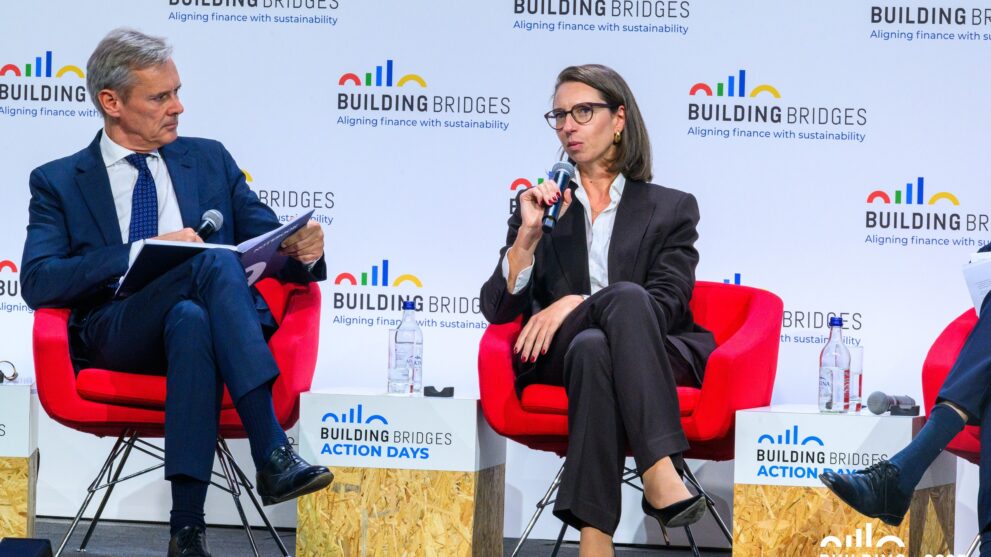
Danielle Brassel, Head of Responsible Investment at Zurich Insurance Group, leads the development and implementation of the company’s global responsible investment strategy. Drawing on nearly two decades of experience, in this interview, she reflects on the broader sustainable investment conversation, highlighting the importance of long-term thinking, credible impact frameworks, and collaboration.
You have been involved with Building Bridges since 2021. How have you seen both the platform and the broader sustainable investment conversation evolve over these past few years?
Over the past few years, the market has become more specific and more honest as it continues to learn and evolve. There has been a shift away from broad commitments and vague, intangible targets toward a stronger focus on what actually works and delivers impact. This evolution is also visible in communications and marketing, which have become more precise and transparent, acknowledging both the opportunities and the limitations of what can realistically be achieved.
At Building Bridges 2025, you explored investment opportunities, regulatory stability, and the role of private capital in Europe’s competitiveness. Why is this conversation particularly important right now?
It is always important. I think it just becomes apparent today, given we are living in a much faster moving world than we had in the past with regulatory and geopolitical uncertainty.
Investors will not put money into markets where you have regulatory uncertainties. I still remember back to pre-2012 when Spain suddenly changed their feed-in structure for renewable energy. So, from one day to another, you no longer could add your produced renewable energy into the grid. With those changes, Spain fell behind in their thought leadership quite a bit.
I just came from a call where very clearly an asset manager said, “We would never invest in a market because of subsidies, because you never know when they are gone.” This is a principle I learned very early on in my career at the European Bank for Reconstruction and Development (EBRD) where we would not work in sectors in emerging markets where they were heavily subsidised.
So, the stability angle is always important. It’s just maybe today, because it’s no longer so stable in many economies, that its importance becomes even more apparent.
Zurich has set clear climate and impact targets, with infrastructure playing a supporting role.
What has been the most important lesson so far in turning these ambitions into investable projects?
Infrastructure plays an important role in supporting our impact targets and climate solution investments. This is because we take an asset-class-specific approach, looking closely at each asset class: what can we do with it, and what are the appropriate strategies? This is in addition to a purely ESG integration approach, meaning risk management. We are looking into “can that asset class actually deliver environmental or social benefits”?
For example, in the private debt space, we have evaluated and analysed infrastructure assets—like solar panels and other critical infrastructure—that contribute to building a more resilient, adaptable, and forward-looking environment. These assets are then classified as impact infrastructure.
Of course, we face the same obstacles as other investors. Pipelines are not large enough, and scaling projects is often difficult due to regulatory challenges. Unfortunately, the regulatory environment is not always favourable or stable for the long-term investments needed. This makes projects less attractive due to volatility, and in many cases, too expensive to deliver a sufficient return.
For many people, “mobilising private capital” can sound abstract. In simple terms, what needs to happen to unlock more long-term investment into sustainable growth?
As an institutional investor, we have a risk-averse investment approach. Anything that carries a risk of losing money or not generating market-rate returns is difficult for us to invest in. It’s not just about returns—it’s about protecting the insurance business model and ensuring we can pay out claims.
What this means is that for certain investments we would like to make, we need de-risking mechanisms. One example is ‘first-loss capital,’ where a portion of the investment comes from actors who can accept lower returns or absorb losses—such as philanthropy, development finance institutions, or governments. This helps make investments viable and can significantly mobilise private capital.
To unlock more private capital, we need stronger collaboration with these actors. There is willingness in the market to create blended finance solutions, but they often don’t materialise because different parties don’t align on their needs. Improving that collaboration will be key going forward.
What role can Building Bridges play in bringing together investors, policymakers, and businesses to turn ambition into real investment on the ground?
Building Bridges already does a strong job in bringing those parties together. That’s what is often missing—the ability to really understand the needs of others. We all tend to think the way we do things is the right way, but there are many ways to get to Rome. The challenge is finding agreement on how to move forward together.
Given the urgency and the speed at which we need to act, we should avoid too much trial and error and focus on aligning and moving forward. Not by cutting corners, but by taking a more pragmatic approach to how we do business.
Solving problems ultimately lies with the participants, but Building Bridges plays an important role as a platform—bringing stakeholders together and sparking ideas on where to go next. I see it as a catalyst, similar to the Hamburg Sustainability Conference.
You also have strong access to senior leadership, which is critical. It requires both a top-down and bottom-up approach: leadership support to enable change, and people on the ground to implement and drive ideas forward. That combination is where Building Bridges can really make a difference.
Looking ahead to 2030, where do you see the most compelling opportunities for insurers to drive both returns and real-world impact through infrastructure investing?
From an insurer’s perspective, there is often a focus on adaptation and resilience. But increased adaptation need comes into play because we haven’t done enough on mitigation. Given limited resources—both in terms of capital and capacity—the more we focus on adaptation, the less we can allocate to mitigation, which is what will matter most in the long run.
So, I believe the biggest, most impactful opportunities lie in mitigation, particularly in emerging markets. This means accelerating the shift away from coal—getting countries like India and China further into renewable energy—and moving away from subsidised oil and gas to reduce emissions more effectively.
In addition, there is a role for nature-based investments to help sequester existing emissions, as well as financing early-stage technologies like carbon capture.
We Build Bridges Storytelling Series
Building Bridges is more than just an event, it’s a space for meaningful collaboration, fresh perspectives, and lasting connections. Through our storytelling series, we highlight the personal experiences that shape each edition. If you have a story to share about your engagement with Building Bridges, whether it’s a key insight, a memorable moment, or the impact of the bridges built, we’d love to hear from you at community@buildingbridges.org.