利用霍尔希姆公司连接资本与实体经济
Following the Post-Building Bridges Executive Lunch in Geneva, we sat down with Antonio Carrillo, Vice-President of Sustainability at Holcim, to hear his thoughts about the role of corporates in the transition towards sustainable finance.
—
Holcim has been a visible real economy voice at recent editions of Building Bridges. What have you found most valuable or unique about the continued engagement?
What struck me from the beginning was the range of topics we were able to engage with. At Building Bridges, from climate action, to nature, all the way across sustainable finance all in the same space. That variety is a unique feature of this forum and its holistic approach is essential. Building Bridges helps us make a crucial connection, which is the link with the financial community. In many global forums, financial actors can feel very far away from the technical discussions. Building Bridges manages to bridge that gap. It brings together capital markets and the real economy in a very practical way.
Is there a conversation or insight from your participation with Building Bridges that has stayed with you or shaped your thinking?
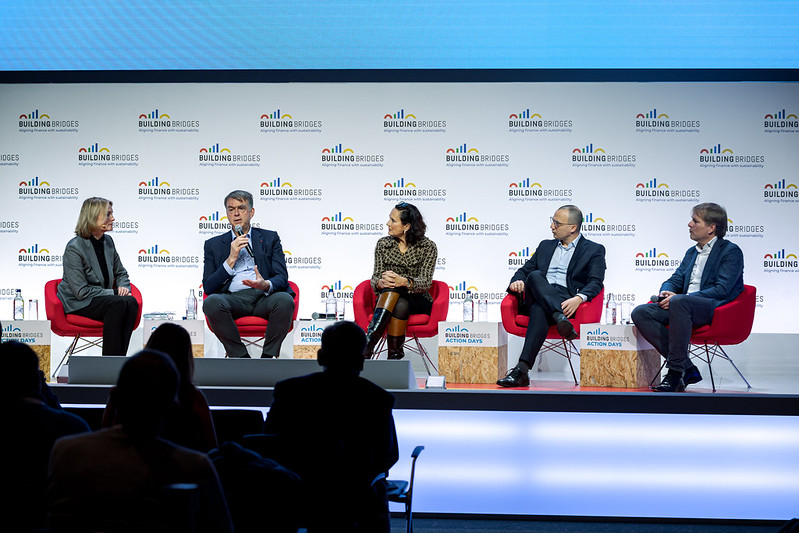
On a personal level, I was genuinely impressed by my interaction with André Hoffmann during my contribution in 2024. I unexpectedly found myself on the main stage (view the session here) due to a series of last minute changes. It was amazing. Holcim had contributed to André’s book on circularity, and so engaging with him in that setting felt like a natural continuation of earlier collaborations. It made me reflect on the role of leadership and vision in the ESG space and on how Building Bridges creates the conditions for constructive, informed dialogue across sectors. Leadership in this space is fundamental. Holcim’s CEO Miljan Gutovic is deeply involved in our strategy, ensuring sustainability is not only the right thing to do, but a driver of profitable growth. Leadership in this transition is paramount, and I am proud that Holcim has consistently been at the forefront of sustainability, climate action and nature action. It is part of our DNA and one of the many reasons people choose to work at Holcim.
转型最终取决于资金和执行力。您认为像Holcim这样的行业领军企业与金融业之间最有合作机会的地方在哪里?
最有利的机遇在于将可信的转型路径与资金支持相结合。金融界必须能够识别可信的转型计划,并准备好为其提供支持。我们不需要更多的管控措施,我们需要的是做好准备并充满信心去支持行之有效的方案。市场也需要有足够的勇气为大规模脱碳项目提供资金,因为这些项目至关重要。投资者可以通过支持那些设定稳健目标、制定清晰计划并付诸实施的公司来巩固转型进展。转型融资领域还有更多值得探索的方向,包括设立专门的转型基金,我希望在不久的将来看到更多此类基金的出现。.
您认为在技术或运营方面,哪些发展将为贵行业的脱碳进程带来最大的动力?
我们的工作重点主要集中在三大方面:开发创新型低碳配方、优化能源结构以及部署碳捕获、利用与封存(CCUS)等先进技术。在配方方面,我们在替代原材料和矿物成分的使用方面取得了显著进展。我们的重点领域之一是扩大煅烧粘土的使用规模,这种粘土可以替代最终产品混合物中的熟料。在能源方面,我们持续增加利用不可回收材料回收的替代燃料。目前,我们在欧洲已有十几家水泥厂使用替代燃料,满足了其80%以上的能源需求。最后,在先进技术方面,Holcim已获得欧盟创新基金的资助,用于开展八个项目。CCUS技术已在其他行业得到验证。现在的重点是将其大规模、经济高效地应用于水泥和建筑材料领域。这将在未来十年实现深度脱碳。我们需要继续完善商业案例,涵盖从资源采集、运输到储存(包括陆上和海上)以及利用的整个价值链。流程中的每一步都需要协调一致、责任明确,并需要公共资金和私人投资的支持,以构建生态系统。.
您今天从苏黎世前往日内瓦。您认为这两个城市如何作为互补的金融中心,凭借强大的产业领导地位,共同助力瑞士实现转型?
苏黎世和日内瓦优势互补,使瑞士在全球转型中处于领先地位。苏黎世拥有深厚的企业和金融实力,而日内瓦则提供国际视野和行业网络。两地携手,将投资者和实体经济参与者汇聚一堂。作为世界可持续发展工商理事会(WBCSD)的创始成员,豪瑞集团长期以来一直是日内瓦可持续发展领域的重要组成部分。自我开始从事可持续发展工作以来,与日内瓦的非金融机构和协会合作对我来说既是自然而然的,也是至关重要的。我们的合作范围不仅限于日内瓦,还延伸至沃韦,并与世界自然保护联盟(IUCN)等组织建立了长期合作关系。火车旅途中,我们可以静心思考,处理一些工作,而且当天即可返回,晚上就能回到家中,非常方便。.
我们搭建桥梁故事系列
Building Bridges is more than just an event, it’s a space for meaningful collaboration, fresh perspectives, and lasting connections. Through our storytelling series, we highlight the personal experiences that shape each edition. If you have a story to share about your engagement with Building Bridges, whether it’s a key insight, a memorable moment, or the impact of the bridges built, we’d love to hear from you at community@buildingbridges.org.